

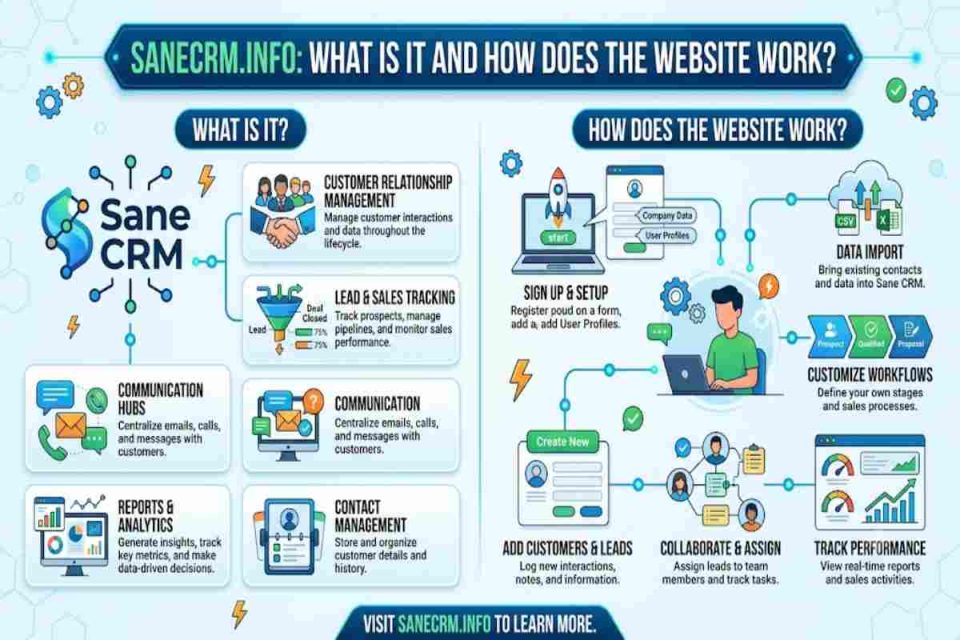
When people search for sanecrm. info, they are usually looking for information about the website, its login page, or the service associated with the domain. The search pattern is particularly interesting because third-party SEO data shows strong demand around variations such as “sancrm info” and “sancrm info login.”
The bigger issue is that spelling matters. Available search and domain records distinguish between sanecrm. info and sancrm.info, so users should confirm the exact web address before entering credentials. This guide explains what can currently be established about the domain, what remains uncertain, and how to approach it safely.
Table of Contents
What Is sanecrm. info?
Publicly available website-monitoring information identifies sanecrm. info with the page title “Ereporting and sales analysis.” A third-party website directory also describes the domain as providing an e-reporting and sales-analysis related page.
That description suggests a business-reporting or customer-management use case, but it is not enough evidence to claim that the website is a mainstream CRM platform comparable with Salesforce, HubSpot, Zoho CRM or Microsoft Dynamics.
This distinction is important. A domain can contain a login or reporting interface without being a broadly marketed SaaS CRM product.
| What can be established | What should not be assumed |
|---|---|
| The domain has been associated with e-reporting and sales analysis | That it is a major commercial CRM provider |
| HTTPS has been observed | That HTTPS alone proves legitimacy |
| Search demand exists for related login terms | That every search result using a similar spelling is the same website |
| The domain has been indexed by third-party services | That all information about the operator is current |
Why Are People Searching for sanecrm. info Login?
The strongest clue comes from search data. Semrush’s May 2026 data lists “sancrm info login” among the domain’s leading organic keywords, with an estimated Indian search volume of 1,000. It also lists “www sancrm info” and “www sancrm” among the leading searches.
This indicates that a significant portion of search intent is navigational: users may already know the service and simply want to reach the correct website.
For a login-oriented query, however, searching Google for a login page is not always the safest approach. A better practice is to use the official address supplied by your employer, organisation, service administrator or previous verified documentation.
A safer login process
- Confirm the spelling of the domain.
- Check that the address begins with HTTPS.
- Look at the complete domain name, not only the page title.
- Avoid entering passwords after following an unfamiliar advertisement or shortened link.
- If the service was provided by an employer or organisation, confirm the URL with its IT or administration team.
- Never reuse an important password on an unfamiliar website.
Is sanecrm. info Safe?
There is no responsible basis for declaring a website completely safe simply because a third-party checker reports no obvious malicious content.
One website-monitoring service currently labels sanecrm.info as “Safe,” while also explicitly noting that its availability of dangerous-content indicators has not been fully explored and that users should treat the result cautiously.
HTTPS has also been detected for the domain.
Those are useful technical signals, but neither establishes who operates a website or whether a particular login request is legitimate.
Practical verdict: treat the site as a domain that requires normal credential-security checks rather than assuming it is either trustworthy or malicious based on a single automated rating.
Sanecrm. info and the Sancrm.info Spelling Difference
This is arguably the most important point for users researching the keyword.
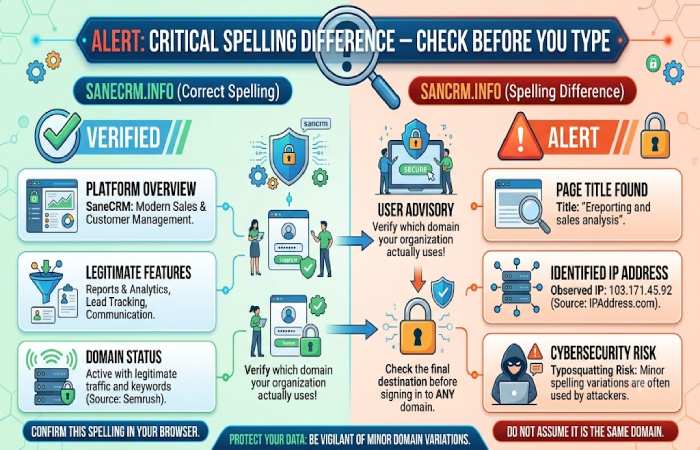
Current search data frequently refers to sancrm.info, without the second “e.” IPAddress.com identifies sancrm.info as a domain with the page title “Ereporting and sales analysis” and reports an observed IP address of 103.171.45.92.
Meanwhile, Semrush has a separate listing for sanecrm.info and reports traffic and keyword data for that spelling.
Therefore, readers should not automatically treat sanecrm.info and sancrm.info as interchangeable addresses.
| Search term | What to check |
|---|---|
| sanecrm.info | Confirm the exact spelling in the browser |
| sancrm.info | Do not assume it is the same domain |
| sancrm info login | Verify which domain your organisation actually uses |
| www sancrm info | Check the final destination before signing in |
This small spelling difference can matter significantly because attackers sometimes rely on users overlooking minor domain variations.
What Do Traffic Data Tell Us?
Third-party traffic estimates provide an interesting picture of the site’s audience.
Semrush reported approximately 708 visits in May 2026, with India accounting for about 80.5% of estimated traffic and the United States about 19.5%. It also reported that direct traffic represented roughly 69.9% of visits, with Google contributing about 30.1%.
These numbers should be treated as estimates rather than first-party analytics. Still, they support the idea that the domain attracts primarily navigational visitors rather than functioning like a large consumer-facing software brand.
Semrush also reported an Authority Score of 8 and 116 referring domains for the domain in its May 2026 dataset.
For beginners, the key takeaway is simple: traffic volume and backlink counts do not prove that a login website is legitimate. They are SEO metrics, not security certifications.
What Should You Do Before Entering Credentials?
If you have been given a sanecrm.info or similarly named login address, use a verification-first approach.
1. Check the domain: Read every character of the address.
2. Check the source: If you received the URL through email, WhatsApp, SMS or another message, verify who sent it.
3. Check the context: If the website is supposed to be an internal CRM or reporting system, your organisation should be able to confirm the correct URL.
4. Check the connection: HTTPS is expected, but remember that HTTPS encrypts the connection; it does not independently prove that the website operator is trustworthy.
5. Protect the password: Never give an unfamiliar website a password that you also use for banking, email or other important accounts.
Frequently Asked Questions
Is sanecrm. info a CRM website?
Available third-party information associates the domain with e-reporting and sales analysis, but there is not enough reliable public information to characterize it as a major commercial CRM platform.
Is sanecrm. info the same as sancrm.info?
Not necessarily. The two spellings represent different domain names, so users should verify the exact address provided by their organisation.
Does sanecrm.info have a login?
Search data shows substantial navigational interest around a similarly spelled “sancrm info login” query, but users should verify the exact login URL before entering credentials.
Is HTTPS enough to trust a website?
No. HTTPS protects data while it travels between your browser and the website, but it does not by itself establish the identity or reputation of the website operator.
Final Verdict
sanecrm. info appears in current third-party web data as a relatively small domain associated with e-reporting and sales analysis, while search behaviour strongly indicates that users are looking for a related website or login service. The most important practical issue is the spelling difference between sanecrm.info and sancrm.info. Anyone attempting to log in should verify the exact domain through a trusted source before providing credentials. Automated safety labels, HTTPS, traffic estimates and SEO metrics can provide context, but none should replace basic credential and domain verification.