

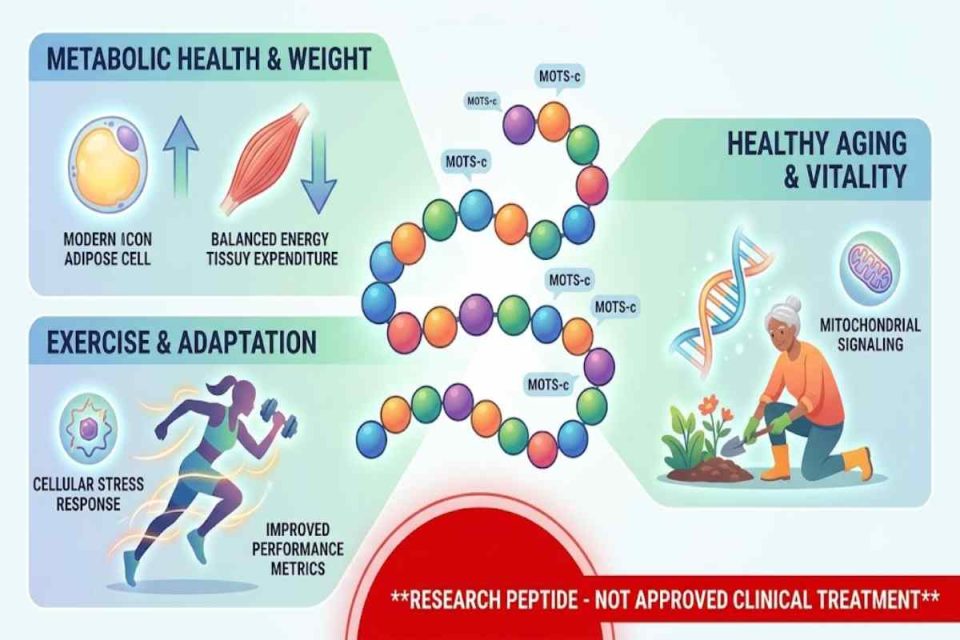
MOTS-c is a 16-amino-acid mitochondrial-derived peptide that researchers are studying for its potential role in metabolic health, insulin sensitivity, exercise adaptation and ageing. Early research, particularly in cells and animals, is promising, but MOTS-c is not an established treatment for these conditions and important questions about its safety and effectiveness in humans remain unanswered.
So, you were looking to see what MOTS-c peptide is used for. You have likely found some information about this particular mitochondrial peptide influencing your metabolism and weight, exercise performance and good old ageing. MOTS-c is a newly discovered, mitochondrial peptide that is gaining popularity in scientific studies as it has many interesting properties related to cellular energy metabolism, but it is important to know that a potentially interesting molecule is very different to an established treatment.
The evidence that MOTS-c has effects on metabolic pathways related to insulin sensitivity, energy balance, and stress responses is consistent and strong based on data obtained from laboratory experiments and from animals; therefore, you cannot conclude that consumption of MOTS-c would induce the same response in humans.
Table of Contents
What Is MOTS-c Peptide?
MOTS-c is abbreviated as mitochondrial open reading frame of the 12S rRNA type-c. It is a short peptide (16 aa) coded from a small open reading frame located in the mitochondrial DNA and was first reported in 2015 when screening for non-characterized signalling factors from mitochondria.
The MOTS-c is a mitochondrial-derived peptide (MDP), unlike the general proteins that are encoded by DNA in the nucleus. This peptide has been shown to participate in mitochondrial-nuclear signaling, especially in situations of metabolical stress.
One proposed mechanism involves the folate-AICAR-AMPK pathway, which is important in cellular energy and metabolic regulation.
What Is MOTS-c Peptide Used For in Research?
So, what is MOTS-c peptide used for? At present, the most accurate answer is: primarily as a research molecule rather than an established clinical treatment.
Researchers are investigating several potential applications:
| Research area | What scientists are investigating | Evidence status |
|---|---|---|
| Metabolic health | Effects on glucose and energy metabolism | Mainly preclinical |
| Insulin sensitivity | Potential influence on insulin resistance | Strong animal/laboratory interest |
| Obesity | Effects on metabolic responses and body composition | Primarily animal research |
| Exercise adaptation | Relationship with exercise and metabolic stress | Early human and experimental evidence |
| Healthy ageing | Changes in MOTS-c levels and ageing-related biology | Early-stage |
| Muscle metabolism | Effects on skeletal muscle energy regulation | Experimental |
| Cellular stress | Role in stress-response signalling | Experimental |
MOTS-c treated mice as stated in the initial animal study were in better metabolic homeostasis and exhibited some resistance toward insulin resistance and diet-induced obesity. These findings then lead researchers to study it further.
MOTS-c and Metabolism
One of the main reasons MOTS-c has attracted attention is its relationship with metabolic regulation.
The evidence to date from in vitro studies suggest that MOTS-c may be involved in the regulation of signaling pathways concerned with glucose utilization and energy balance. In particular, effects seem significant in skeletal muscle, a primary tissue responsible for glucose clearance.
However, a mechanism observed in cells or animals does not automatically translate into a clinically useful treatment.
MOTS-c and Exercise
Exercise is another area of interest. Human research has investigated changes in circulating mitochondrial-derived peptides following resistance and endurance exercise. This supports the idea that MOTS-c may be connected with the body’s response to physical stress.
That does not mean MOTS-c should be regarded as an exercise-performance drug. There is currently insufficient evidence to establish reliable performance benefits from taking synthetic MOTS-c.
MOTS-c and Healthy Ageing
MOTS-c is also being studied in the context of ageing. Reviews report that circulating MOTS-c levels may decline with age, although tissue-specific patterns are more complicated. Therefore, human observational research has found differences between circulating and skeletal-muscle MOTS-c levels across age groups.
This has prompted further investigation into the potential of MOTS-c being utilized in relation to age associated metabolic changes. It is still too early to describe MOTS-c as an anti-ageing treatment.
How Does MOTS-c Work?
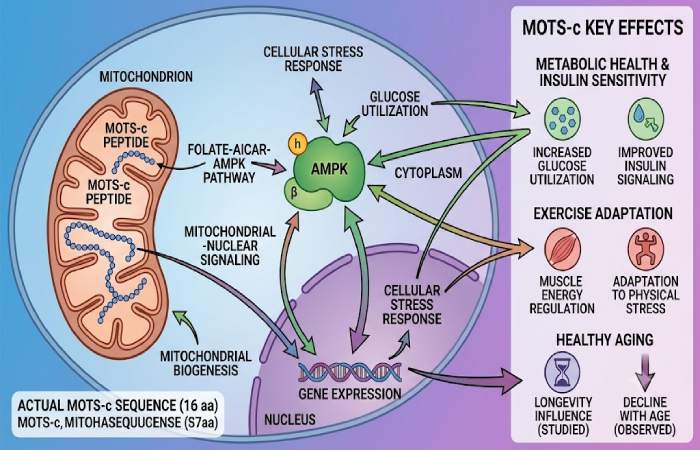
A simplified research model looks like this:
Metabolic or exercise stress → MOTS-c signalling → cellular metabolic pathways → possible changes in energy and stress responses
One pathway frequently discussed is AMPK, an important cellular energy sensor. MOTS-c appears to interact with metabolic processes that can influence AMPK activity. Researchers are also studying how the peptide moves between mitochondria, the cytoplasm and nucleus under particular conditions.
The biology is interesting, but the precise mechanisms are still being investigated.
What Can You Realistically Expect?
This is where online discussions about MOTS-c can become misleading.
You should not assume that research findings mean MOTS-c will:
- cause significant weight loss;
- build muscle automatically;
- reverse ageing;
- treat diabetes;
- improve athletic performance;
- increase lifespan.
Most of the strongest findings have come from experimental models. Human research is much more limited.
In a review of MOTS-c by a 2023 paper, the authors indicate the therapeutic benefits of the molecule, but also the need for further investigation prior to it’s clinical use.
A Practical Evidence Workflow
When evaluating a claim about MOTS-c, use this sequence:
1. Identify the claim
For example, “MOTS-c improves insulin sensitivity.”
2. Check the type of evidence
Was the result found in cells, mice or humans?
3. Look for controlled human trials
Animal findings cannot establish human effectiveness.
4. Check regulatory status
A research peptide is not automatically an approved medicine.
5. Consider safety and product quality
This becomes especially important if the peptide is being marketed for injection.
This approach helps separate legitimate scientific interest from exaggerated online marketing.
Is MOTS-c Approved as a Medicine?
This is one of the most important points for consumers.
The US Food and Drug Administration (FDA) currently identifies MOTS-c in its compounding-related safety information and states that it has not identified human exposure data for drug products containing MOTS-c administered by any route. The agency also raises concerns about potential immunogenicity and peptide-related impurities.
Therefore, readers should not confuse the existence of scientific publications with regulatory approval.
The FDA’s substance database also identifies MOTS-c as a recognised chemical substance, but that database listing should not be interpreted as approval for therapeutic use.
MOTS-c Benefits vs Limitations
| Potential area of interest | What research suggests | Main limitation |
|---|---|---|
| Glucose metabolism | Promising biological effects | Limited clinical evidence |
| Insulin sensitivity | Positive findings in experimental models | Not established as human treatment |
| Weight regulation | Effects observed in animal studies | Human effectiveness uncertain |
| Exercise response | Associated with metabolic stress and exercise | Performance benefits unproven |
| Ageing | Interesting association with ageing biology | Not an approved anti-ageing therapy |
| Muscle metabolism | Mechanistic research is promising | Clinical relevance remains uncertain |
Who Should Consider MOTS-c?
For most people, MOTS-c should currently be viewed as a research topic rather than a self-directed treatment option.
Someone researching MOTS-c may be interested in mitochondrial biology, metabolic health, ageing research or emerging peptide science. People considering an injectable peptide should discuss it with a qualified healthcare professional rather than relying on online dosage protocols or vendor claims.
Those who are pregnant, have chronic medical conditions, take prescription medicines or are considering an injectable research peptide should be particularly cautious.
Are MOTS-c Peptides Sold Online Legitimate?
The word “research” on a product label does not necessarily establish that a product is suitable or safe for human use.
Product quality can vary, and issues such as identity, purity, contamination, storage and peptide-related impurities can matter significantly for injectable products. So the FDA has separately warned about risks associated with unapproved peptide products and notes that unapproved products do not receive the same pre-market review for safety, effectiveness and quality.
For that reason, purchasing a vial online and assuming that it has pharmaceutical-grade quality is not a safe conclusion.
MOTS-c Alternatives: What Is Better Established?
If your goal is metabolic health, weight management or improving fitness, established approaches have substantially more evidence behind them.
Therefore, depending on the individual, these may include:
- a balanced diet based on overall nutritional needs;
- regular aerobic and resistance exercise;
- adequate sleep;
- evidence-based treatment for diagnosed metabolic conditions;
- clinically appropriate weight-management programmes;
- medicines approved for specific conditions when prescribed by a doctor.
MOTS-c research may eventually contribute to future therapies, but it should not currently replace established medical care.
Frequently Asked Questions
What is MOTS-c peptide used for?
What is MOTS-c peptide used for? Primarily, it is being studied as a mitochondrial-derived signalling peptide with potential roles in metabolism, insulin sensitivity, exercise adaptation and ageing. It is not an established treatment for these conditions.
Is it a weight-loss peptide?
MOTS-c has produced metabolic and anti-obesity effects in some animal studies, but there is not enough high-quality human evidence to establish it as a weight-loss treatment.
Does MOTS-c increase muscle?
Research suggests MOTS-c has biological effects involving skeletal muscle metabolism, but there is insufficient evidence to say that using MOTS-c reliably increases muscle mass in humans.
Is MOTS-c safe?
Human safety data remain limited. The FDA has specifically identified concerns about the lack of human exposure data for drug products containing MOTS-c and potential peptide-related safety issues.
Is it FDA approved?
MOTS-c should not be treated as an FDA-approved medicine. The FDA’s current information highlights significant gaps in human safety information rather than establishing MOTS-c as an approved therapeutic product.
Conclusion
So, what is MOTS-c peptide used for? At present, its most defensible use is scientific research into mitochondrial signalling, metabolism, exercise responses and ageing biology, rather than routine medical treatment. Early studies provide compelling reasons for further investigation, but they do not yet establish MOTS-c as a proven therapy for weight loss, diabetes, ageing or athletic performance.
For consumers, the sensible approach is to distinguish promising laboratory research from established human medicine. Until stronger clinical evidence and appropriate regulatory pathways are available, MOTS-c should be approached as an experimental research subject rather than a proven health solution.