

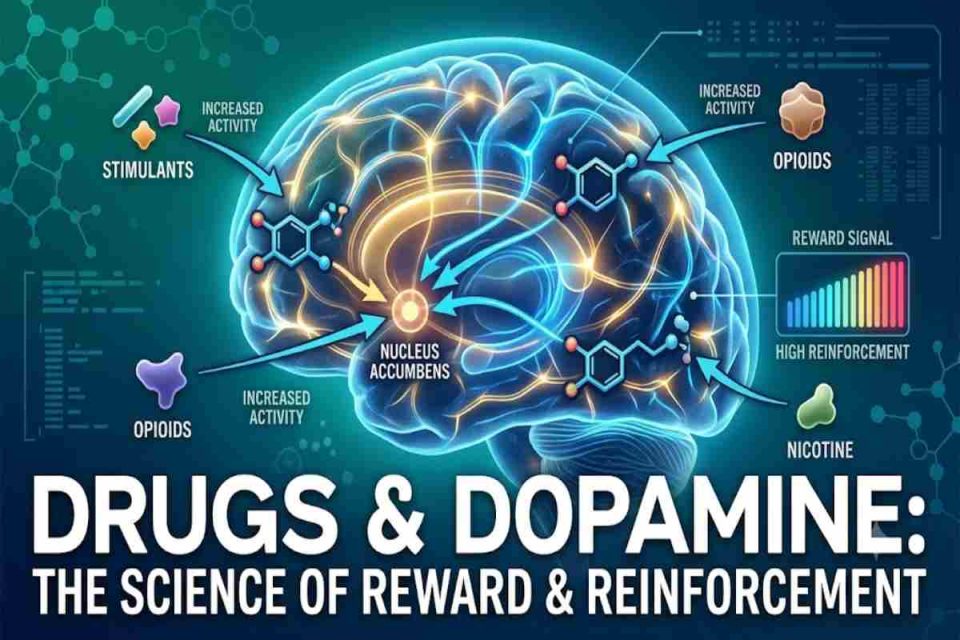
Drugs that affect the brain by increasing dopamine activity are commonly associated with misuse because dopamine plays an important role in the brain’s reward and reinforcement pathways. Substances can increase dopamine directly or indirectly, but their effects and addiction risks vary considerably between drug types.
The missing word for this definition, Drugs which act on the brain by enhancing _ activity are most commonly misused is dopaminergic. Dopamine is one of the most significant neurotransmitters as it is involved with reinforcement, motivation, learning and the reward system. Addictive drugs cause changes in dopaminergic pathways and are likely to activate paths which integrate with the nucleus accumbens.
But there’s an important difference: the dopamine released isn’t just about ‘pleasure’. It also helps us learn that something is an experience we should seek to repeat, which starts to explain why prolonged contact with certain drugs becomes reinforcement for their use.
Table of Contents
Drugs That Affect the Brain by Increasing Dopamine Activity
Dopamine is produced naturally in the brain and is involved in several normal functions, including movement, motivation, attention and reward-related learning.
When a person experiences something rewarding, dopamine signalling can help the brain recognise the experience as important. Drugs with addictive potential can interfere with this system and produce unusually strong or rapid changes in dopamine signalling.
Different substances achieve this in different ways. For example, cocaine primarily increases dopamine by blocking its reuptake, while amphetamines can increase dopamine release as well as affect reuptake.
Why does dopamine matter?
The dopamine pathway rewards specific actions with pleasure and motivation. Through repeated usage, these rewarded pathways can be modified in people who are at risk for compulsive and drug-seeking behavior.
However this does not say everyone with elevated levels of dopamine would be an addict. Biological, psychological, developmental and social factors also play a part in substance use disorders.
Examples of Substances That Affect Dopamine
Several categories of psychoactive substances can influence dopamine signalling.
| Substance or class | Relationship with dopamine | Examples |
|---|---|---|
| Stimulants | Can substantially increase dopamine signalling | Cocaine, amphetamines |
| Nicotine | Activates pathways that increase dopamine release | Tobacco and nicotine products |
| Opioids | Indirectly increase dopamine through effects on reward circuitry | Heroin, morphine, fentanyl |
| Alcohol | Acts on several systems and can indirectly increase dopamine | Alcoholic drinks |
| Cannabis | THC can influence dopamine-related reward pathways | Cannabis |
| MDMA | Affects dopamine as well as other neurotransmitters | MDMA/ecstasy |
The mechanisms are not identical. Some drugs act directly on dopamine transporters, while others influence dopamine indirectly through other neurotransmitter systems.
How Drug-Related Dopamine Activity Works
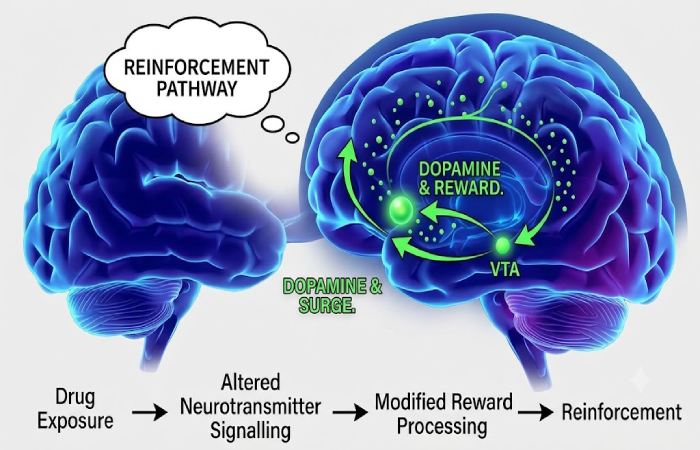
A useful way to understand the process is to look at it as a sequence.
Simple workflow
Drug exposure → changes in neurotransmitter signalling → altered reward processing → reinforcement → repeated use in some individuals
In the case of psychostimulants like cocaine, dopamine is allowed to stay in the synaptic space longer because reuptake of dopamine is blocked by the drug; amphetamines can cause increase release of dopamine.
Prolonged exposure could be associated with neuroadaptations. Changes to processing rewards, motivation, and drug related cues are likely involved.
It’s important to understand, however that this isn’t an open-ended road to addiction. Vulnerability, use patterns, doses, setting and other factors all play a role.
Dopamine and Addiction: What the Evidence Shows
Dopamine has been implicated throughout research into addiction for its role in the rewarding and reinforcement properties of drugs of abuse. Looking at the neuroscience of reward from drugs of abuse indicates that drugs of abuse result in dopamine release in the nucleus accumbens through both direct or indirect effects on dopamine neurons.
The National Institute on Drug Abuse (NIDA) also explains that addictive drugs can produce large surges in neurotransmitter signalling within the brain’s reward circuitry. Dopamine helps reinforce behaviours by signalling that an experience is important and worth remembering.
The speed and size of dopamine changes can also matter. Faster increases may produce stronger reinforcing effects, although the relationship between dopamine, subjective pleasure and addiction is more complicated than a simple “more dopamine equals more pleasure” explanation.
Dopamine Does Not Explain Every Drug Effect
One common misconception is that all drugs of misuse work in exactly the same way.
They do not.
For example:
- Stimulants can strongly affect dopamine transport and release.
- Opioids primarily act on opioid receptors but can indirectly increase dopamine.
- Alcohol affects several neurotransmitter systems.
- Classic hallucinogens primarily act through serotonin receptors and have a different pharmacological profile.
Therefore, dopamine is an important part of the explanation, but it is not the only neurotransmitter involved in substance use disorders.
Common Misconceptions About Dopamine
| Misconception | More accurate explanation |
|---|---|
| Dopamine is only the pleasure chemical | It is also involved in motivation, learning and reinforcement |
| More dopamine always means more happiness | Dopamine signalling is complex and context-dependent |
| Every dopamine-increasing substance is equally addictive | Addiction potential varies substantially |
| Addiction is simply a lack of willpower | Substance use disorders involve biological, psychological and social factors |
| Prescription stimulants are identical to illicit stimulants | Their effects depend on the drug, dose, formulation and pattern of use |
Expectations: What Can You Really Conclude?
Words such as “drugs that stimulate the brain by enhancing dopamine levels,” are suitable to answer an elementary question, but they are not a proper definition for the concept of abuse of drugs.
Not every drug acting on dopamine will be abused, and not every individual exposed to dopamine-influencing drug substance will acquire addiction disorder.
Just like that, dopamine is not to be understood as addiction alone. So the current theory of addiction sees it as a disorder characterized by the rewarding circuitry, learning processes, stress response, genetics, context and alteration of various systems in the brain.
Why Some Drugs Are More Reinforcing Than Others
The way a substance reaches the brain can influence how rapidly its effects develop. Therefore, research indicates that the speed of dopamine changes is relevant to a drug’s reinforcing effects. Faster delivery to the brain can produce a more rapid change in dopamine signaling.
This is one reason researchers distinguish between the pharmacological properties of substances rather than simply grouping every psychoactive drug together.
The delivery method, pharmacology, amount, personal factors and past history of exposure will have an influence on the quality and potential for problematic consumption.
When Drug Use Becomes a Health Concern
Drug use is especially worrying in cases when the usage is maintained when it should be ceased because of negative effects, or when there is a diminishing ability to control the extent of its consumption.
Potential warning signs can include:
- Strong cravings
- Difficulty reducing or stopping use
- Spending substantial time obtaining or using a substance
- Continuing despite health, relationship or work problems
- Developing tolerance
- Experiencing withdrawal symptoms with some substances
Anyone concerned about their own substance use or someone else’s should consider speaking with a qualified healthcare professional or addiction service rather than trying to manage a serious problem alone.
Conclusion
The answer to “drugs that affect the brain by increasing ______ activity are the most commonly misused ones” is dopamine. Dopamine is central to the brain’s reward and reinforcement systems, helping explain why many addictive substances can encourage repeated use.
However, it is a far more complex picture than just dopamine, and addiction cannot be oversimplified to just this single neurotransmitter. There is so much variability to how various drugs bind to various receptors and act with differing neurotransmitter systems; additionally, personal vulnerability, lifestyle and habituation also play key parts. So clarifying these variations provides a greater understanding of how substance dependence is capable of arising, and the necessity of clinical guidance.