

Table of Contents
What Does “jfk je” Mean?
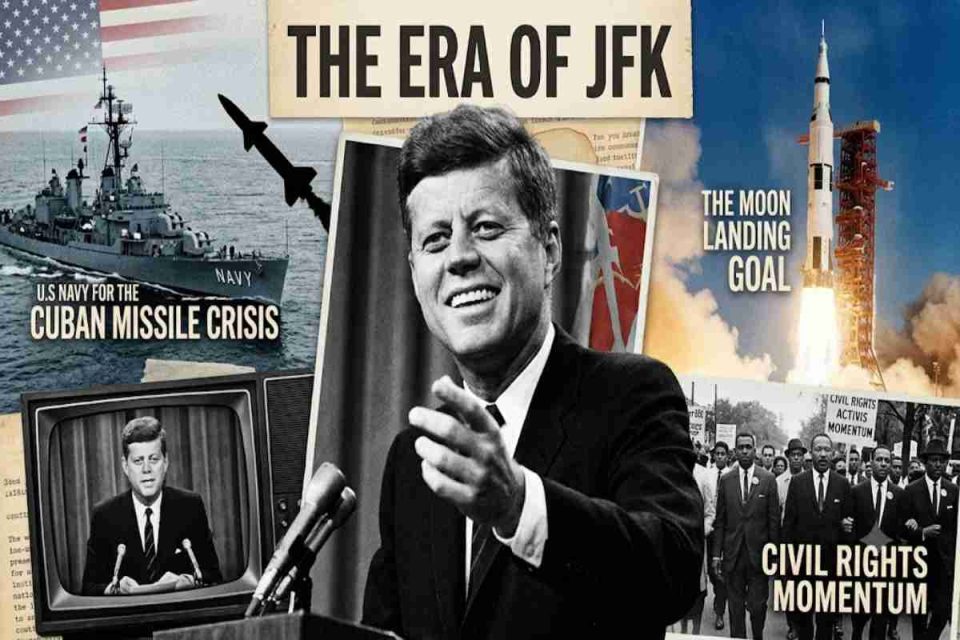
The phrase “jfk je” is ambiguous, but JFK most commonly refers to John Fitzgerald Kennedy, the 35th president of the United States. In other contexts, JFK can refer to John F. Kennedy International Airport or other institutions named after him.
In historical searches – the most obvious is that it would refer to John F. Kennedy, America’s most recognizable president, partly thanks to a brief presidency during high tension in the Cold War, the space race, the civil-rights movement, and one of modern history’s most explored political assassinations.
Who Was John F. Kennedy?
John Fitzgerald Kennedy, who was born on May 29, 1917, in Brookline, Massachusetts. Kennedy received his university education at Harvard, was involved with military affairs during the Second World War (working within the U.S. Navy), was active in politics after his military service, and was eventually elected to the House of Representatives in 1946.
Kennedy later became a U.S. senator for Massachusetts. In the 1960 presidential election, he defeated Republican candidate Richard Nixon and became president on January 20, 1961.
At 43, Kennedy was one of the youngest people elected president. His campaign promoted generational change, public service and national ambition. These ideas became associated with his New Frontier programme.
| JFK Fact | Details |
|---|---|
| Full name | John Fitzgerald Kennedy |
| Born | May 29, 1917 |
| Birthplace | Brookline, Massachusetts |
| Political party | Democratic |
| Presidency | 1961–1963 |
| President number | 35th |
| Vice president | Lyndon B. Johnson |
| Major crisis | Cuban Missile Crisis |
| Major technological goal | Moon landing |
| Assassinated | November 22, 1963 |
| Location | Dallas, Texas |
JFK’s Presidency and New Frontier
Kennedy’s New Frontier represented an ambitious approach to American government. His administration focused on economic growth, education, healthcare, civil rights, scientific research, and national security.
His communication style was equally significant. Kennedy understood the growing influence of television and used speeches to present the presidency as energetic, modern and forward-looking.
But the reality was rather more complex. Kennedy was thwarted by Congress, challenged by a fractured coalition of supporters, and faced a cruel selection of hard decisions that involved such difficult choices in negotiations with the Soviet Union and Cuba as well as decisions on civil rights.
His presidency lasted less than three years, but it contained several events that shaped American history for decades.
The Cuban Missile Crisis
The Cuban Missile Crisis was arguably the most dangerous moment of Kennedy’s presidency.
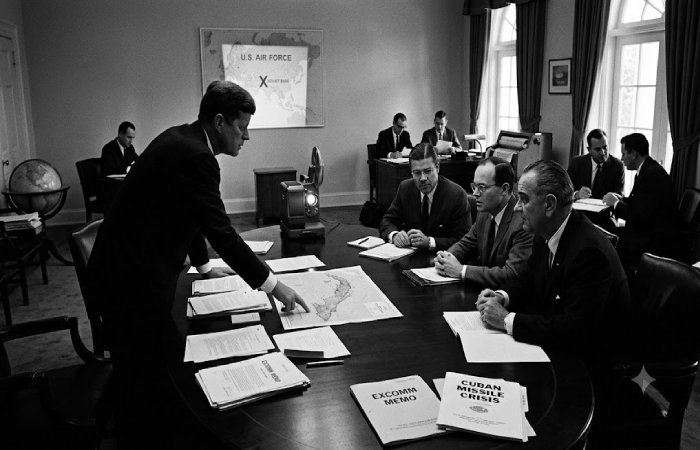
In October 1962, American surveillance discover Soviet nuclear missile installations being develop in Cuba. Because Cuba is located close to the United States, the discovery created an immediate national-security crisis.
Kennedy and his advisers considered military action, including an air strike. Instead, the administration imposed a naval “quarantine” around Cuba while demanding that the Soviet Union remove the missiles.
For approximately thirteen days, the United States and Soviet Union faced the possibility of nuclear conflict.
The crisis eventually ended through negotiation. The Soviet Union agreed to remove its missiles from Cuba. The United States publicly pledged not to invade Cuba and privately agreed to remove Jupiter missiles from Turkey.
| Cuban Missile Crisis Stage | What Happened |
|---|---|
| Discovery | U.S. intelligence detected Soviet missile sites |
| Assessment | Kennedy’s advisers considered possible responses |
| Quarantine | U.S. naval forces restricted military shipments |
| Negotiation | Washington and Moscow communicated |
| Resolution | Soviet missiles were removed from Cuba |
| Aftermath | Both countries pursued measures to reduce future risks |
The significance of the crisis goes beyond whether Kennedy “won”. It demonstrated how nuclear confrontation could quickly become catastrophic and showed the importance of combining military pressure with diplomacy.
JFK and the Space Race
Kennedy’s presidency also closely connecte to America’s space ambitions. In May 1961, he announced the goal of landing an American astronaut on the Moon and returning that person safely to Earth before the end of the decade.
The United States was competing against the Soviet Union in the Cold War, and space achievements had become symbols of scientific and technological capability.
Kennedy’s Moon objective required enormous investment. The programme stimulated advances in engineering, computing, communications, propulsion and manufacturing.
His 1962 Rice University speech became one of the best-known statements of the American space effort. Kennedy argued that the country should pursue the Moon precisely because it was difficult.
| Space Race Area | JFK-Era Significance |
|---|---|
| Moon exploration | Established a national objective |
| NASA | Received strong political support |
| Engineering | Accelerated advanced technical development |
| Scientific research | Increased attention and investment |
| Aerospace industry | Expanded large-scale development |
| Education | Increased interest in science and engineering |
| Cold War | Became part of technological competition |
Kennedy did not live to see the Moon landing. Apollo 11 eventually achieved the objective in July 1969, when Neil Armstrong and Buzz Aldrin became the first humans to walk on the Moon.
JFK and Civil Rights
Kennedy’s civil-rights record requires careful examination.
When he entered office in 1961, racial segregation and discrimination remained widespread in parts of the United States. His administration initially approached some civil-rights issues cautiously because of political opposition, particularly among Southern Democrats.
Growing protests and national pressure gradually changed the political environment.
In June 1963, Kennedy delivered a nationally televised address describing civil rights as a moral issue affecting the entire country. His administration subsequently supported comprehensive civil-rights legislation.
The most significant historical point between Kennedy and the Civil Rights Act is that Kennedy did not sign it since the United States then-president, John F. Kennedy, was unfortunately murdered in November of 1963. The bill was later passed and signed into Law under President Lyndon B. Johnson, who succeeded him.
What Happened to JFK?
John F. Kennedy assassinate on November 22, 1963, in Dallas, Texas, while traveling in a presidential motorcade. Vice President Lyndon B. Johnson became president later that day.
Kennedy’s assassination immediately became a major national and international event. It generated investigations, government reports, testimony, photographs, films, and intelligence records.
The Warren Commission concluded that Lee Harvey Oswald was responsible for Kennedy’s assassination and found no evidence that a foreign government or another individual had participated in a conspiracy.
Nevertheless, public debate has continued for decades.
JFK Assassination Records
The John F. Kennedy assassination records are part of the U.S. National Archives and consist of more than six million pages of records plus all related material. Interest in the assassination has been revived because previously unreleased records continue to be declassified.
Of course, a document appearing for the first time does not automatically justify a new hypothesis. The historical researcher has to answer the question of the date of the document, the authority of the person or organization responsible for its creation, the factuality of the content, and compare it against other sources.
And this difference matters now, in the age of social media, when you’ll often see documents, articles or excerpts presented outside of their original, surrounding context.
| Assassination Record Issue | Why It Matters |
|---|---|
| Government documents | Provide primary-source evidence |
| Intelligence records | Help researchers examine historical investigations |
| Photographs and films | Provide visual evidence |
| Witness testimony | Adds firsthand accounts |
| Newly released files | Can clarify previously restricted information |
| Historical context | Helps determine how reliable individual claims are |
JFK Timeline
| Date | Event | Importance |
|---|---|---|
| May 29, 1917 | Kennedy born | Beginning of his life |
| 1946 | Elected to U.S. House | Entered national politics |
| 1952 | Elected to Senate | Became a major political figure |
| 1960 | Won presidential election | Defeated Richard Nixon |
| Jan. 20, 1961 | Inaugurated | Became 35th president |
| May 1961 | Moon objective announced | Accelerated U.S. space ambitions |
| Oct. 1962 | Cuban Missile Crisis | Major nuclear confrontation |
| Sept. 1962 | Rice University speech | Major statement on space exploration |
| June 1963 | Civil-rights address | Strengthened federal civil-rights position |
| Nov. 22, 1963 | Assassinated | Presidency ended |
| July 1969 | Apollo 11 Moon landing | Kennedy’s Moon goal achieved |
JFK: Myth vs. Historical Reality
| Common Perception | Historical Context |
|---|---|
| JFK transformed America alone | His administration faced major political constraints |
| Kennedy completed the Moon landing | He established the goal; Apollo 11 landed after his death |
| Kennedy signed the Civil Rights Act | The 1964 law was signed by Lyndon B. Johnson |
| Cuban Missile Crisis was a simple victory | Resolution involved concessions and negotiation |
| His presidency solved major domestic problems | Many issues remained unresolved |
| New records automatically change assassination history | Individual documents require careful evaluation |
Why Is JFK Still Important?
Kennedy’s historical importance extends beyond his personality and public image.
First, the Cuban Missile Crisis remains an important case study in crisis management. It shows how leaders must make decisions when every available option involves significant risk.
Second, the space program demonstrates how government investment can mobilize science, engineering and industry around a specific national objective.
Third, Kennedy’s use of television helped establish modern presidential communication. His ability to communicate directly with the public influenced political campaigning and presidential media strategy.
Finally, the assassination demonstrates how historical memory can persist for generations. The enormous archival collection surrounding Kennedy’s death continues to attract historians, journalists and researchers.
Final Thoughts
The most useful way to understand “jfk je” is to look beyond the familiar image of Kennedy as a young and charismatic president.
His presidency lasted less than three years, yet it included a nuclear crisis, an ambitious Moon program, significant developments in civil-rights policy and major changes in presidential communication.
Kennedy’s legacy is therefore more complicated than either admiration or conspiracy theories suggest. His administration achieved important objectives while also facing serious limitations.