


A useful home-improvement website should do more than collect attractive rooms and renovation buzzwords. The real test is whether its advice helps a reader make a better decision—whether that means rearranging a living room, improving a backyard, choosing materials, or simply making a space feel more personal.
That is where home-hearted.com is hosted. The site describes itself as a destination for home inspiration, interior design, landscaping and cooking, with its central theme summarized as “Homes made of art and heart.” Its navigation currently includes Home Ideas, Interior Design, Landscaping the Yard and Cooking with Love.
However, there is an important distinction between home inspiration and expert home-improvement guidance. The site contains a broad mixture of practical articles, lifestyle content, DIY topics and newer commercial or business-oriented material. Readers should therefore evaluate individual articles rather than assuming every recommendation carries the same level of authority.
Table of Contents
What Is Home-Hearted .com?
Home-hearted .com is a home-and-lifestyle publishing website covering several areas of residential living. Its current homepage features content about outdoor furniture, backyard improvements, gravel driveways, flood-resilient architecture, exterior wood maintenance and landscaping.
The site’s categories also extend into interior design and cooking. This makes it broader than a traditional interior-design blog.
The editorial mix can be grouped into four main areas:
| Content area | Examples | Best suited for |
|---|---|---|
| Home ideas | Room layouts, décor and organization | Beginners |
| Interior design | Furniture, colors, architectural styles | Home decorators |
| Landscaping | Backyards, outdoor spaces and exterior improvements | Homeowners |
| Cooking | Recipes and kitchen-related content | Lifestyle readers |
| Home repairs | Maintenance, renovation and materials | DIY-minded readers |
Being so broad makes it also a problem – readers of the site need to discern when it is inspiration, general or technical advice.
What Can You Find on the Website?
The site’s content library is considerably broader than its homepage tagline suggests.
Current and archived material includes articles about closet doors, kitchen design, garage doors, backyard landscaping, home maintenance, recipes, and renovation. The website also has dedicated categories for topics such as home repairs and business.
To an unfamiliar homeowner, this kind of scope is extremely valuable since most projects will probably begin with an equally straightforward query:
What can I change without completely renovating my home?
In the site’s low-budget makeover materials, for example, readers find suggestions ranging from repainting furniture to rearranging it to reusing a mix of secondhand finds.
These all could be really good ideas for anyone renting and/or owning a home where you may not be ready for the more serious home remodel project.
Home Design Advice: Where the Site Is Most Useful
The strongest use case is arguably idea generation. Many homeowners are intuitive: they know that the room isn’t working in some way, but can’t explain it logically. An article on redesign or design will often offer helpful tips: for example, rearrangement of existing furniture; the introduction of textiles and different surfaces; a plan for better lighting; some new storage space; or a focal piece for visual interest.
The room-makeover stuff on the website follows the same practical approach. Its articles address budgets, styles, updating room décor by seasons, and making a space feel your own. These are topics beginners are likely to find far more user-friendly than complex architecture or building information.
A Better Way to Use Design Inspiration

Do not copy a room photograph item-for-item. Instead, extract the underlying design principle.
For example:
- A small room may benefit from furniture with a smaller visual footprint.
- A dark room may need better lighting before it needs more decoration.
- A cluttered room may need storage rather than additional furniture.
- An empty room may need a clear focal point.
- An outdated room may require better proportions rather than expensive accessories.
This approach turns online inspiration into a practical decision-making tool.
Does It Offer Budget-Friendly Home Ideas?
Yes. Budget-conscious decorating is one of the site’s more accessible themes.
Its room makeover material highlights several low-cost approaches, including:
- Reusing existing furniture
- Repainting older pieces
- Upcycling household objects
- Shopping for second-hand décor
- Rearranging furniture
- Creating DIY artwork
- Refreshing rooms seasonally
The important point is that a makeover does not necessarily require buying a completely new collection of furniture.
In fact, starting with what you already own can be the more sensible approach. It lets you identify what is genuinely missing before spending money.
Landscaping and Outdoor Living Content
Outdoor spaces are another significant part of the publication.
The homepage currently features material covering backyard functionality, outdoor furniture, gravel driveways, retaining walls and landscaping.
This category is particularly relevant because outdoor improvements can range from inexpensive aesthetic changes to technically demanding construction.
For example:
| Project | Typical complexity | Professional input may be needed? |
|---|---|---|
| Planting beds | Low | Sometimes |
| Outdoor furniture arrangement | Low | Usually no |
| Decorative gravel | Low–medium | Sometimes |
| Drainage improvements | Medium | Often |
| Retaining wall | Medium–high | Potentially |
| Structural landscaping | High | Often |
| Flood-resilience work | High | Yes, depending on project |
An ornamental landscaping project is frequently a DIY process. Drainage features, structural retaining walls, electrical work, or considerable regrading are more typically professional tasks where safety, structural design, and local building codes are at issue.
Therefore, use lifestyle articles to develop ideas—but verify technical decisions through qualified professionals and local regulations.
What About DIY and Home Maintenance?
The website also publishes maintenance-related content covering subjects such as garage doors, plumbing, exterior materials, and home repairs.
This is an important category because preventative maintenance is usually less glamorous than a room makeover but can be considerably more valuable.
A sensible homeowner’s priority should generally be:
Safety → water intrusion → structural problems → mechanical systems → efficiency → aesthetics.
Following that order will avoid a very obvious mistake: wasting money on a cosmetic overhaul while there are things that will be far costlier if left unchecked.
For instance, painting a wall does not come first if there is water coming in behind it. Nor will the decorating of a garage fix an unsafe garage door.
How Reliable Is the Information?
This is where readers should take a more critical approach.
The website contains useful general-interest material, but its content should not automatically be treated as professional engineering, architectural, medical, electrical, or legal advice.
There is also evidence of a very broad editorial mix. The current homepage includes home-design articles alongside content concerning online entertainment, business partnerships and other subjects that are not directly related to home improvement.
That breadth can reduce topical consistency.
A strong E-E-A-T approach therefore means checking:
- Who wrote the article?
- Does the author demonstrate relevant expertise?
- Are technical claims supported?
- Is the advice current?
- Does the article distinguish opinion from established guidance?
- Are product recommendations transparent?
- Does the project require local building-code verification?
- Is professional inspection recommended where appropriate?
For low-risk decorating inspiration, these concerns are relatively minor. For structural or safety-related work, they become much more important.
Is Home-Hearted .com Legit?
There are two different questions here:
Does the website exist and publish content? Yes. Its official site is active and contains a large library of home, lifestyle and related articles.
Should every article be treated as independently verified expert advice? No.
That distinction is essential.
A third-party automated website-rating service currently gives the domain a low trust score and labels it suspicious. However, algorithmic trust scores are signals rather than definitive proof that a website is fraudulent.
Readers should therefore avoid both extremes:
- Do not automatically assume the site is unsafe because of an automated score.
- Do not automatically assume every article is authoritative simply because it appears on an established-looking website.
For practical decisions involving significant money or safety, independent verification is the better standard.
Who Should Use the Website?
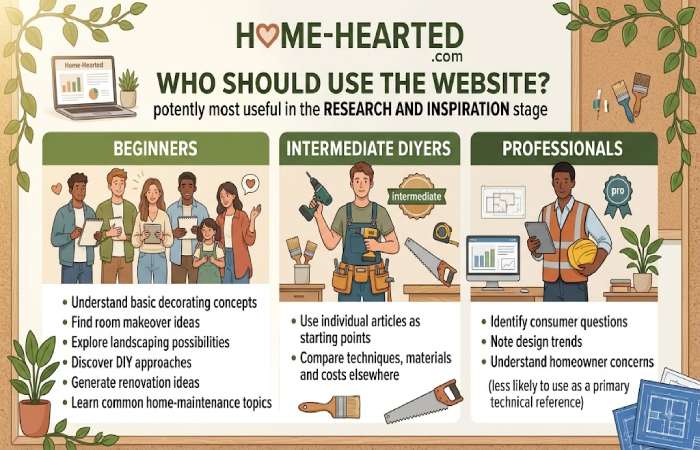
The site is potentially most useful for people in the research and inspiration stage of a project.
Beginners
Beginners can use it to:
- Understand basic decorating concepts
- Find room makeover ideas
- Explore landscaping possibilities
- Discover DIY approaches
- Generate renovation ideas
- Learn common home-maintenance topics
Intermediate DIYers
Intermediate readers can use individual articles as starting points before comparing techniques, materials and costs elsewhere.
Professionals
Professionals are less likely to use the site as a primary technical reference, but its articles can still be useful for identifying consumer questions, design trends and homeowner concerns.
What Are the Main Strengths?
The strongest aspects of the website are its breadth and accessibility.
1. Wide topic coverage
The site covers interiors, outdoor spaces, maintenance, cooking, and lifestyle rather than focusing on one narrow design style.
2. Beginner-friendly concepts
Many articles approach home improvement through practical questions rather than highly technical terminology.
3. Budget-conscious ideas
The makeover content emphasizes using existing belongings, repurposing furniture, and making incremental changes.
4. Inspiration beyond interiors
Readers can also explore outdoor improvements, landscaping, and home maintenance.
What Are the Weaknesses?
The weaknesses are largely connected to the site’s broad editorial strategy.
1. Topic dilution
The website covers a very large number of subjects. That can make it difficult to establish the same level of authority across every category.
2. Uneven expertise
A beginner decorating guide and an article involving structural home repairs should not be judged by the same editorial standard.
3. Limited distinction between inspiration and technical guidance
Readers need to determine when an article is offering an idea versus when it is making a recommendation that requires professional validation.
4. Mixed commercial content
The site’s current library includes business and partnership-related articles alongside its home content.
For readers, this means editorial intent should be considered before acting on a recommendation.
A Smarter Way to Use Home-Hearted .com
The best strategy is to treat home-hearted .com as an idea-generation and early-research resource, not as the only source for an expensive or technically complicated project.
A practical workflow looks like this:
Step 1: Discover the idea
Use design, landscaping or renovation articles to understand what is possible.
Step 2: Define the project
Turn the inspiration into a specific objective.
Instead of “make my backyard better,” define it as:
“Create a low-maintenance seating area for four people.”
Step 3: Establish the budget
Separate materials, labor, delivery and unexpected costs.
Step 4: Check technical requirements
For structural, electrical, plumbing, roofing or major landscaping work, consult appropriate professionals and local requirements.
Step 5: Compare alternatives
Never rely on one article when choosing expensive materials, contractors or systems.
Step 6: Start with the highest-impact improvement
The most attractive project is not always the most useful one.
Final Verdict
home-hearted .com is best understood as a broad home-and-lifestyle inspiration platform rather than a specialist technical authority.
Its strongest value is helping readers move from “I want my home to feel better” to “Here are several realistic ways I could improve it.” Its room-makeover, décor, landscaping, and general home-maintenance material can be useful during that discovery phase.
For decorating ideas, layout inspiration, and low-risk DIY projects, the site can be a useful starting point. For expensive renovations or work involving structural, electrical, plumbing, roofing, or safety concerns, use its content as one research input and verify important decisions independently.
Frequently Asked Questions
What is Home-Hearted .com mainly about?
It is a home-and-lifestyle website covering home ideas, interior design, landscaping, cooking, and related homeowner topics.
Is the website useful for beginners?
Yes. Its budget decorating and room-makeover material is accessible to people who are relatively new to home improvement.
Can it replace professional home-improvement advice?
No. Technical projects involving structural systems, electrical work, plumbing, major landscaping or safety issues should be verified through qualified professionals and applicable local requirements.
Does the site cover outdoor spaces?
Yes. Its current content includes backyard design, landscaping, outdoor furniture and other exterior-home topics.
Should readers trust every article equally?
No. Evaluate each article based on its author, evidence, subject matter, freshness and the potential consequences of following the advice.